


Edinburgh information & Attractions Page Contents
Edinburgh information
Edinburgh attractions Places to Visit
Palace of Holyrood House
Holyrood house located at the bottom end of the Royal Mile in Edinburgh is The Queen's official residence in Scotland. Originally Founded as a monastery in 1128, the Palace was closely associated with Scotland's turbulent past. Mary Queen of Scots lived here between 1561 and 1567. Successive kings and queens have made the Palace of Holyroodhouse the premier royal residence in Scotland. Today, the Palace is the setting for State ceremonies and official entertaining.
Our Dynamic Earth
Our Dynamic Earth is one of Edinburgh's most exciting, "must see" attractions. Take a thrilling journey back in time and learn about our planet Earth
Getting to Our Dynamic Earth is easy. The building is situated in the heart of Edinburgh at the foot of Arthur's Seat, adjacent to the Palace of Holyroodhouse and the site of the new Scottish Parliament.
The Royal Mile
The Royal Mile is Edinburgh's most famous street. Starting at the bottom of the Royal
mile are the following interesting buildings:
Edinburgh Castle
Edinburgh Castle located high above the City of Edinburgh on an extnct volcano has had a commanding view over the city since 1085.
The Castle itself, like many of Edinburgh's landmarks, has a chilling past. Its hilltop position made it an ideal location for a prison, for many centuries illustrious men endured imprisonment, torture, and the maiden (the Scottish version of the guillotine) on the castle grounds. Today, the Castle is the most visited of all Scottish Monuments, and many tourists comment on its unique mixture of beauty and foreboding.
In front of the castle is the Castle Esplanade with an unrivalled view of the cobblestoned streets of the Old Town, and the bustling activity of the city's financial sector, the New Town. The Esplanade is the location of the annual Edinburgh Tattoo that draws torists fromallover the world.
John Knox's House
Tron Kirk
The Tron Kirk stands at the junction of North Bridge and The Royal Mile. It has been witness to many a Hogmany celebration at the Tron, traditionally the gathering place of Edinburgh folk at New Year.
Over the last few years considerable work has been undertaken on ther interior, excavating the cellar and discovering the ruins of ancient Edinburgh. It is now open as a visitors centre where you can view the work to date, explained with pictures of before and after the work started.
St. Giles' Cathedral
The High Kirk of Edinburgh, St. Giles' Cathedral, is generally regarded as the mother church of Presbyterianism. The Cathedral was officially consecrated by the Bishop of St. Andrews in 1243, however its four massive central pillars date back to approximately 1120. The 'kerk werk'(old dialect for 'construction')of St. Giles was largely funded by Merchant Guilds, ship dues and fines.
The church was named after St. Giles, a saint popular throughout France, in support of the Auld Alliance of Scotland and France against England; their common and much hated enemy. After the Reformation, John Knox became St. Giles' first minister
Princes Street
There cannot be many cities in the world where the foremost shopping street has an uninterrupted view of an historic, medieval castle due to retail outlets being built along one side of the street. But that is Edinburgh' Princes Street. In the more commercially minded city of Glasgow, there are some Philistines who think that Princes Street is only half built...
Princes Street was part of the "New Town" of Edinburgh, which was built in the latter half of the 18th-century during the reign of the Hanoverian King George III. Princes Street was named after King George's sons but only after the King had objected to its original name St Giles Street, the patron saint of the city.
This description of Princes Street is divided into two sections the south side of the street which includes the gardens and castle and, on the second page, a quick tour of the retail outlets on the north side of the street.
Princes Street Gardens
It is a surprise to many visitors to find that, tucked underneath Edinburgh Castle and running the full length of the gardens is a railway line going into Waverley Station. The Victorians, with their enthusiasm for railways, did not have to contend with City Council planning regulations and conservation groups! Thankfully, however, they did create a deep cutting so that it is not visible from the street but in the days of steam, the trains puffing their way from the station could be heard and the smoke seen billowing into the sky.
The railway companies often built luxurious hotels beside their main stations and Waverley Station was no exception. Originally built as the North British Hotel, the renamed Balmoral Hotel is seen on the right of the picture above. Leading off Princes Street is the Waverley Bridge beside the station. Tour buses and buses to the airport leave from here.
At the corner of Waverley Bridge and Princes Street and beside the station is the Princes Mall. This is two and a half floors of small boutique shops and a food court selling fast food. Most of this building has been constructed under ground. On the top, is the main tourist information bureau where you can get advice about the city and book accommodation in Edinburgh.
The 200 feet high Sir Walter Scott Monument dominates this end of Princes Street. The stonework has blackened over the years and currently has a "piebald" effect from recent repairs. There are 287 steps to the top but the views from there of the Edinburgh skyline (if you can make it up all those stairs) are tremendous.
High above East Princes Street Gardens is the Bank of Scotland head office (which is lit up at night as the picture here shows). In order to ensure that nobody built in front of them, the Bank bought the land in front, part of which has become East Princes Street Gardens.
The first road off Princes Street on the south side is "The Mound". Originally, the old city of Edinburgh ran down the "spine" of the Royal Mile from the castle to the Palace of Holyroodhouse. There was a stagnant "Nor' Loch" below the castle which was used as a receptacle for sewage. With the building of the "New Town" a street called The Mound (see above) was built of waste material which linked the old and new parts of the city. In the 19th-century, the Royal Scottish Academy and the National Gallery of Scotland, with their Grecian style columns, were built at the junction of The Mound and Princes Street. Near the top of The Mound are the twin spires of what was once the Church of Scotland Assembly Hall now the temporary home of the Scottish Parliament. The picture above was taken from just in front of the Parliament building, looking north.
On the other corner of The Mound is the famous Floral Clock. This is replanted every year and the moving hands of the clock as well as its face are covered in plants, mainly sempervivums. Above the clock stands a carrara marble statue of Allan Ramsay. Across the gardens and clinging to the side of the rock beside the castle are the houses of Ramsay Gardens.
Further along Princes Street is the striking equestrian memorial to the Royal Scots Greys. Nearby, within the gardens themselves, is the Scottish American War Memorial. Also in the gardens at this point is the Ross Bandstand. This is not used very often, except during the Edinburgh Festival.
At the far end of the gardens, the water in the gilded Ross Fountain (pictured here) did not flow for many years but a joint project involving Edinburgh City Council and East of Scotland Water has got it going again with the water being recycled as required by current environmental regulations.
At the far end of the south side of Princes Street are two churches St John's at the corner of Lothian Road and St Cuthbert's (the large building in the foreground of the picture above, which was taken from the ramparts of Edinburgh castle in winter time, after a fall of snow).
Just as Princes Street began with a former railway hotel, it ends with another one. This time it is the large, red sandstone structure of the Caledonian Hotel, visible on the left of the picture here. This is a favourite stopping off place for Sean Connery and many other celebrities.
Edinburgh Walking tour looking at the unusual
Ghost and Gore Walking Tour of Edinburgh
The award-winning Edinburgh ghostly walks have been a major attraction since 1984. They are famous throughout this world and beyond. A unique and highly entertaining tour expertly presented by costumed guides (summoned from the spirit world). Do not be surprised when you encounter several mysterious apparitions along the way!This tour is seasonal and only operates from May through to August.
Secrets of the Royal Mile
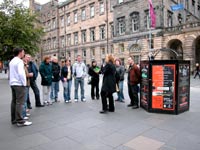
The Royal Mile is a treasure chest of historic gems just waiting to be opened. Stroll with an expert guide down through the centuries and learn of Scotland's cultural, criminal and political past. Marvel at the splendor of Parliament Hall and hear how a nation gained a throne but ultimately lost its sovereignty. Meet the celebrated author of 'The Strange Case of Dr Jekyll and Mr Hyde'. Discover why, to this day, Scots spit on a stoney heart and what it was about Britain's oldest equestrian statue that shocked the ladies so.
Ghost Hunter TrailWalking Tour
In days of old townsfolk would gather at the Mercat Cross to enjoy gruesome and bloody entertainment. Continue this age old tradition with a terrifying late-night stroll. Walk through a deserted, moonlit churchyard and into Haunted Underground Vaults and feast your ears on tales of the macabre told theatrically by your cloaked guide. It's late, it's dark and it ends in a graveyard, this special late-night walk caters for the truly brave!
Edinburgh Historic Vaults Afternoon Walking Tour
Extensive scientific research carried out on The Edinburgh Ghost Project 2001 found abnormally high levels of paranormal activity in Edinburgh's Underground Vaults. A catalogue of eyewitness accounts of strange, inexplicable events and supernatural occurrences confirm the experts' findings. Enter the vaults if you dare and hear Learn the sinister history of Edinburgh from a guide as you explore the underground vaults
More Information or Book Vaults Tour
Walking The Vaults & Old Town.
A longer tour similar to the Historic vaults tour but also includes some of the old town and Complimentary refreshment in candle-lit Megget’s Cellar.
walls could talk, these are the stories they would tell! A great bridge is built spanning a deep valley to the south of the Royal Mile and under its 19 enormous arches in a catacomb of underground chambers a community begins to thrive. Trades, both legal and illicit, flourish and in these hard times there is nothing that cannot be bought or sold for a purse of gold! Journey back to this time with our university trained historian and learn of life in these recently uncovered 18th-century vaults.
Murder and Mystery Walking Tour of Edinburgh
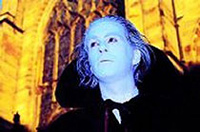
Take a look at Edinburgh's dark side, including tales of witchcraft, plague and torture. Visit the scenes of many horrific tortures, murders and supernatural happenings as you walk along eerie alleyways and creepy courtyards of the Old Town. Your ghostly guide will blend history with humor and facts with fables, while "jumper ooters" provide guaranteed ghastly appearances.This tour operates all year round
Open top sightseeing double decker bus
City Sightseeing Hop On Hop Off Tour of Edinburgh
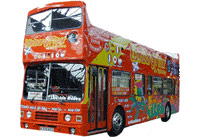
I, 2,3 or 5 Day Tours
From Edinburgh to either
- Skye 3 Day
- Loch Ness 1 Day or 2 Days
- Stirling Castle and Loch Lomond
- Isles of Iona, Mull and Skye 5 day tour
- St Andrews and Fife 1 day tour
- Scottish Wilderness Tour Inverness and the Highlands
- The Edinburgh Dungeon
- Stirling Castle and Loch Lomond 1 day tour
- The Royal Yacht Britannia
- Lake District and Hadrian's Wall 3 day tour
- Inverness, Loch Ness and the Highlands 2 day tour
